
Gaps Upon the Surface
on the republishing of Larry Sultan and Mike Mandel's Evidence

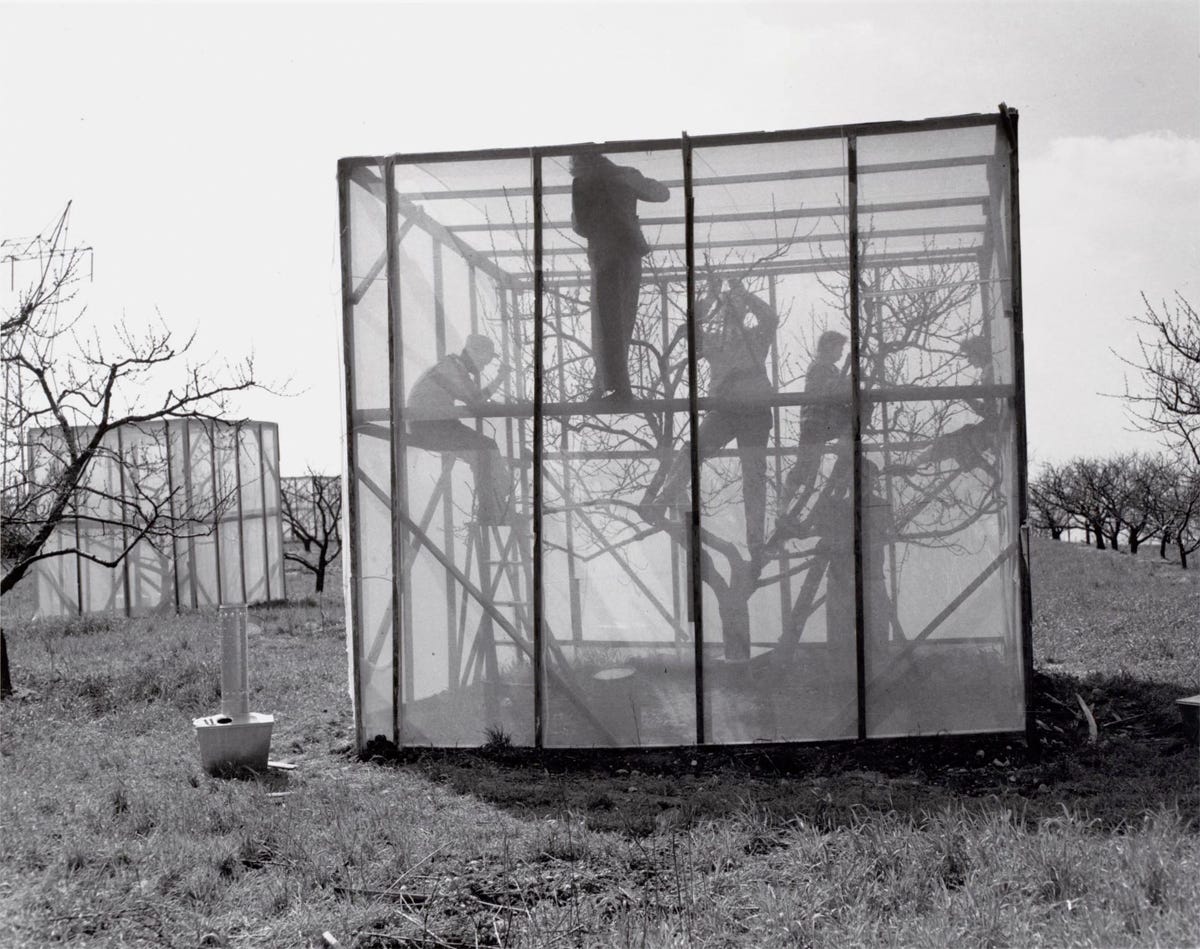
I. Cunning Objects
The facticity of a photograph is found precisely in the visual elements contained within the four edges of its frame, nothing more. If there is any meaning to be applied to (or gleaned from) the photograph, this meaning is contingent upon a discursive network surrounding it, namely: the caption, the viewer, the environment, and all other contextualizing information situated outside of the frame. And yet, because of its unprecedented fidelity—what Marshall McLuhan would describe as the photograph’s “high-resolution”—we convince ourselves that the meaning of the photograph precedes these external influences, and that it arrives to us with an already-fixed significance; an ontological cunning to which we have given ourselves over in spite of our own agency in the formation of its meaning.1 Like Simone de Beauvoir’s woman, the meaning of the photograph is not born, but rather becomes. And only once this meaning has been established may we call the photograph an image.
The photograph is an empty sign. Coined in 1966 by the French structural linguist Émile Benveniste, the “empty sign” designates things “that are nonreferentia with respect to ‘reality.’”2 In his Problems in General Linguistics, Benveniste was giving particular attention to words whose meaning shifts depending on their utterance (for example, “you” and “I,” whose signified persons change depending on who speaks and who is spoken to). As a linguistic object, the photograph too is empty and beholden to a malleability which begets an ever-shapeshifting and unresolved meaning, and the utterance that shapes its meaning is not found in mere speech-acts, but rather with each encounter between the viewer and the photograph. Newspapers, photo books, social media feeds, the gallery wall, and any other place an image may be found operate as sites for potential utterances, and thus sites of endless meaning-making. Yet, in spite of the photograph’s malleability, authorial claim and direction may in fact accompany and inform the image, found in the caption sitting below or beside the frame and made all the more concrete by the photograph’s fixed place on a page or wall. All the while, the photograph sits there without the chance to ever provide testimony, never able to explain that it means nothing but what it presents on its glossy surface. When McLuhan claimed that the photograph was a hot medium—suggesting that a photograph, like other hot media, would function like a lecture rather than a seminar—perhaps his interpretation was unknowingly contingent upon the interpretive structure that has fixed every image into its meaningful place.3 Ultimately, the photograph is, as Roland Barthes would say, a “message without a code.”4 And yet we convince ourselves that the photograph contains a code to be deciphered, rather than something upon which we invent and insist a code to be present.
In 1977, artist-duo Larry Sultan and Mike Mandel published a photobook which would bring these semiotic conditions (and problems) of the photograph to light. Titled Evidence, the work consisted of 59 photographs borrowed from the archives of various institutions, mostly but not limited to those based in California (from small police municipalities to industry titans such as Lockheed Aircraft Corporation).5 Rather than explain (or even suggest) the significance of each photograph, the artists removed all contextualizing information, merging disparate archives together to formulate a speculative narrative that was at once uncanny in its ambiguity, yet descriptive enough for each viewer to sense a novel technological trajectory unique to the decades following World War II. Though undergirded by a dry sense of humor and absurdism, Evidence arrived after an historical moment in which truth was at a crisis: “a post-Watergate work” as Sandra S. Phillips notes in her catalog essay included in the second edition of Evidence.6 The years leading up to the publication of Evidence would find the American people enduring an abject reckoning with power as they witnessed a dissolving legitimacy in the office of the president, whose significance as a position bound to ideals of truth and leadership had been compromised. Over time, Evidence became a cult-classic and rare object within the photography world, resting on the bookshelves of connoisseurs and on the wishlists of aspiring patrons. Twenty six years later, a second edition of Evidence would be published, and from there the book would receive subsequent editions at a half-life cadence in 2017 and 2024. Given the sociopolitical conditions that influenced the creation of the project, it seems to reason that the republishing of the book would demand attention to the historical conditions that anticipated the project’s return.7 Considering that the widest gap of time between republishing occurs between the first and second edition, this paper will pay particular attention to the social contingencies that may have motivated the projects first return in 2003, and consider how the project’s semiotic revelation continued (and continues) to maintain purchase and offer a clue as to what is at stake when (violent) political tactics are bound in an overdetermination of the image as a truth-telling device.
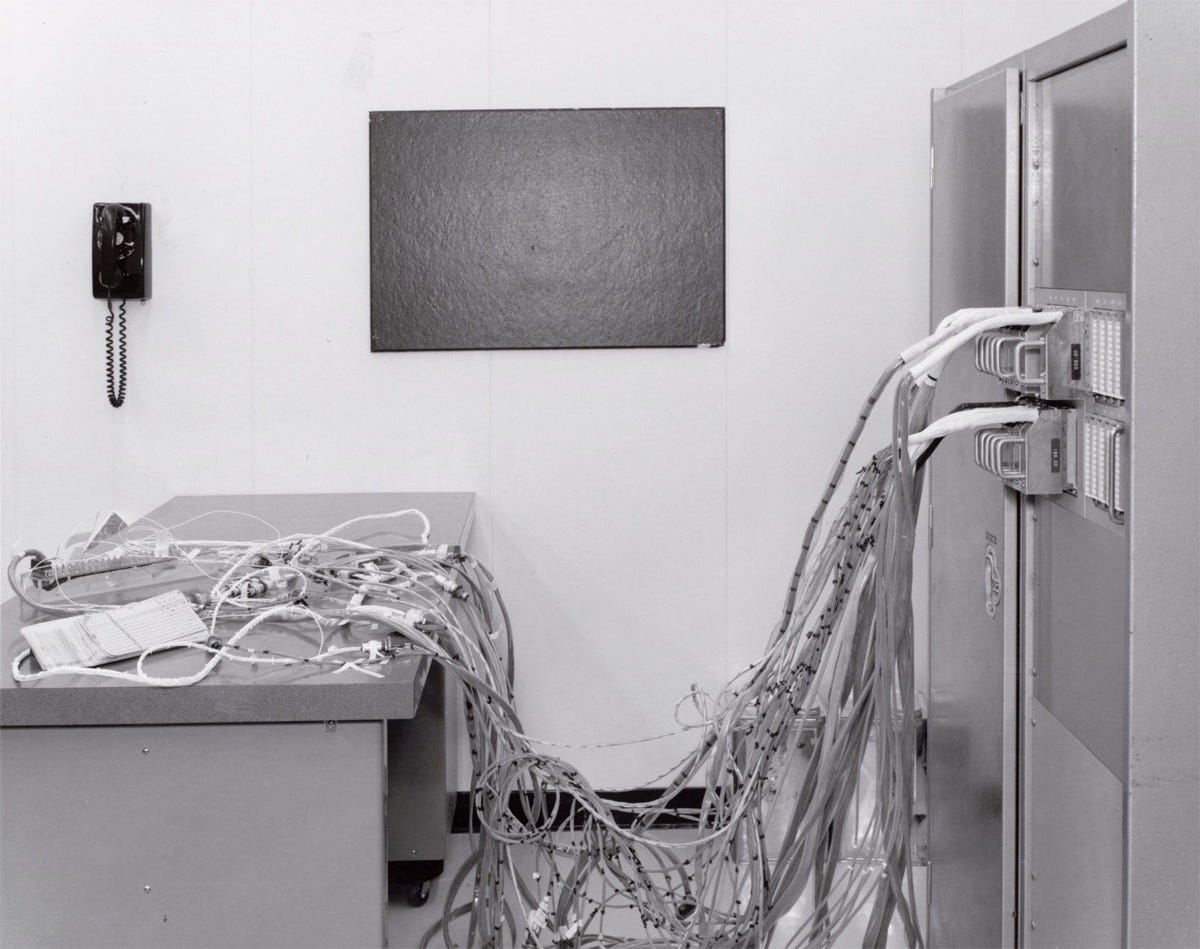
II. Information Exchange
In his book The Control Revolution, David Beniger presents a table that outlines the “modern societal transformations identified since 1950,” spanning from the lonely crowd of 1950, to the second industrial divide of 1984. The transformation highlighted in 1977, the year Evidence was first published, is the information economy.8 The late-1970s would indeed find itself to be a period of proliferating computation, quantification, and subsequent data to mine, analyze, distribute, and ultimately be put to use for profit. By the time Sultan and Mandel published their book, the information sector comprised almost half of the civilian labor force alongside the service, industry, and agriculture sectors.9 Though an aim of this sector was a certain form of sense-making and distribution of mass information, the subsequent technologies that were developed and aiding in the sector’s rise would remain discrete, operated by specialists behind opaque office doors. The personal computer developed for the everyman would only begin to find its place in the consumer’s home in the late 1970s, and would not be the mass-consumer object it is today until the decades to follow.
Sandra S. Phillips suggests a narrative in Evidence which points to this moment of profound technological change. She writes: “Evidence [...] engages the loss of belief provoked by that era and an examination of the resulting ambivalent relationship of people to the new machines.”10 As one peruses the pages of the book, they encounter image after image seemingly made inside the offices and factories utilizing these new machines. Indeed, the images inside Evidence are emblematic of a moment in time in which technologies whose aim was to make sense of the world were advancing at an exponential rate, while faith in structures once believed to be infallible was dissolving. How the publication seems to resolve this contradiction is by exposing the discrete gaps within information processing itself. The ambiguity of the photographs—many of which are gleaned from the archives of institutions whose purpose was to bring greater clarity to the world’s information—subvert the assumption that information is a given, and instead highlight the processing power that must be enacted in order for any meaning to come to fruition. Perhaps the inclusion of many human figures throughout the book too draws attention to the human-element contained within and necessitating these myriad systems of processing which we take for granted, or credit too much to the machines we built. What Evidence might suggest is that although the rise of computation and information technologies would subsume much of the labor force, the industry was nevertheless contingent upon human interpretation. As one holds Evidence and speculates on what it is they are seeing as they move from spread to spread, they become their own participant in the information-sector, performing an interpretive labor as they draw conclusions and construct their own meaning from the several dozen photographs. Without the aid of a single presupposed narrative, the conclusions they arrive at will be born of nothing more than their own desire and authorship that they bring to the publication, and without an official or “correct” interpretation, each constructed narrative will ultimately become and function as its own truth.
III. Desired Truth; Violent Authorship
In his first series of lectures at the Collège de France, entitled Lectures on the Will to Know, Michel Foucault describes truth as “a third element between desire and knowledge.”11 There are two important things to consider in this framework: for one, desire does not necessarily point to a peaceful origin or outcome (and is certainly never born out of passivity, for one must act upon their desire). Secondly, the knowledge that is produced by the search for truth remains subjective, and the truth that emerges between knowledge and desire would more accurately represent itself within scare quotes. As far as photography is concerned, Foucault’s desire→ truth → knowledge framework appears to be resonant with Susan Sontag’s articulation of photographic interpretation when she states:
“a photograph that brings news of some unsuspected zone of misery cannot make a dent in public opinion unless there is an appropriate context of feeling and attitude…photographs cannot create a moral position, but they can reinforce one—and can help build a nascent one.” 12
This “feeling and attitude” that Sontag describes points to an already-formulated desire, thus situating the photograph as not a means to an end, but rather an object already situated within a desired end. In other words, photographs cannot sway desire, but only reify a desire already held by the viewer. Foucault and Sontag’s claims become alarmingly relevant as we consider the violent socio-historical contingencies preceding the second edition of Evidence.
Such a contingency would be found in an event on February 5th 2003, when Colin Powell gave an address to the United Nations in order to justify the U.S.-led Invasion of Iraq. This address functioned as a certain form of truth-making and knowledge-production, prefigured by an imperial desire to quash the advancement of a country—and more broadly, a global region—from advancing its own mission (in this case, Iraq, which would be invaded by the United States in the following month). Towards the beginning of his presentation, Powell presents a slideshow of images and states to his listeners at the United Nations (and broader American public watching his address on C-SPAN):
Let me say a word about satellite images before I show a couple. The photos that I am about to show you are sometimes hard for the average person to interpret, hard for me. The painstaking work of photo analysis takes experts with years and years of experience, poring for hours and hours over light tables. But as I show you these images, I will try to capture and explain what they mean, what they indicate to our imagery specialists.
[...]
Here, you see 15 munitions bunkers in yellow and red outlines. The four that are in red squares represent active chemical munitions bunkers. How do I know that? How can I say that? Let me give you a closer look. Look at the image on the left. On the left is a close-up of one of the four chemical bunkers. The two arrows indicate the presence of sure signs that the bunkers are storing chemical munitions. The arrow at the top that says security points to a facility that is the signature item for this kind of bunker. Inside that facility are special guards and special equipment to monitor any leakage that might come out of the bunker. 13

Powell’s reliance on photographic evidence is notable, if not dubious, for several reasons: he admits plainly that even he, the narrator of the address, has difficulty interpreting the images that he presents. But regardless of this discrepancy, Powell continues to offer a decisive explanation of the images, going as far as to include information that exists outside the photograph (such as the “special guards and equipment” supposedly inside the buildings pictured). The photographs in Powell’s slideshow become what Theodor Adorno called sensuous signs, in which “representation triumphs over what is represented.”14 In the case of the satellite image projected within the halls of the United Nations, it is not a mere image of a munitions bunker, but rather a representation that fits neatly within a schema that will justify an imperial desire for invasion. That such an apparently sensitive image would be presented in a public forum, for every American layman with television access to witness, would suggest that the satellite image’s true function is to be precisely such an ideological representation (for if it were an image of legitimate military strategy, why would the administration broadcast it so widely?). In other words, the satellite image’s true meaning—within the context of Powell’s narration—is nowhere to be found inside its frame, but rather within the complex network of ideological construction occurring outside of the image.
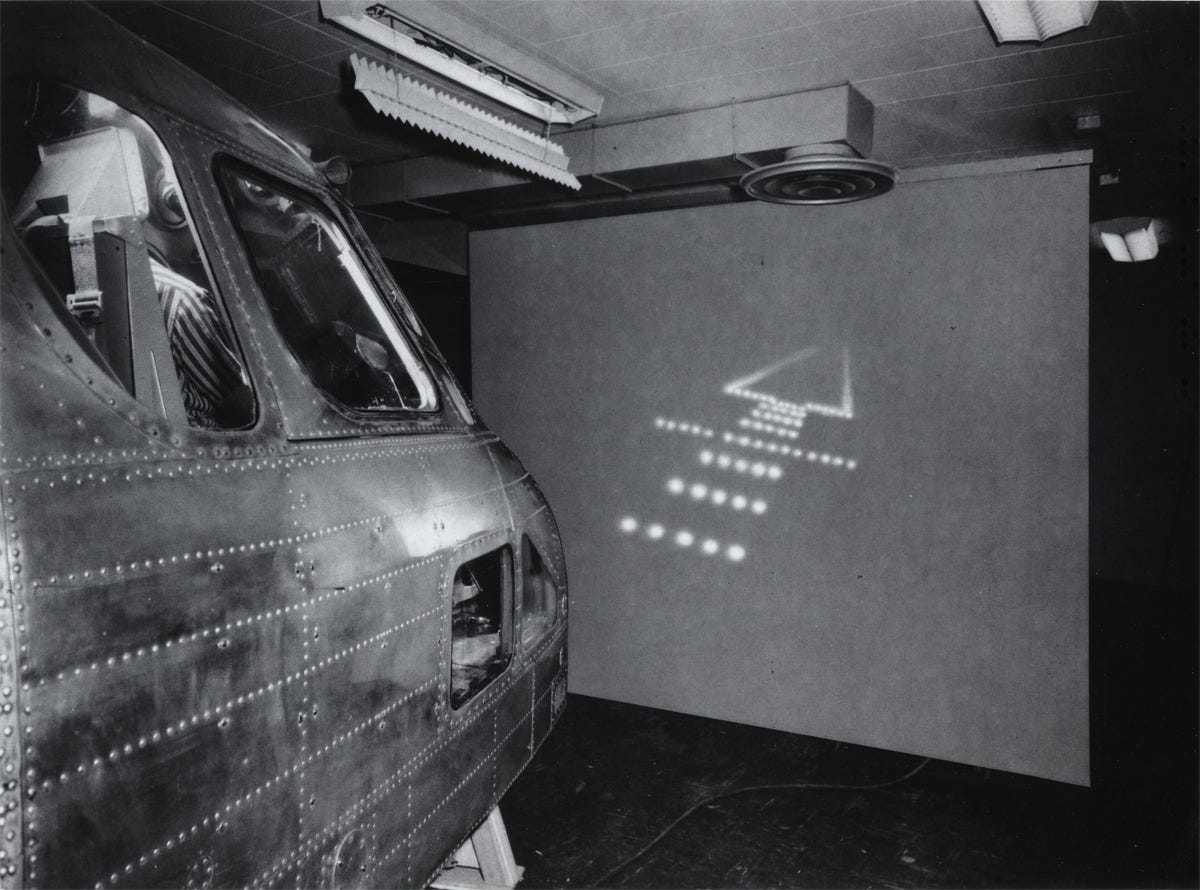
Both from the San Fernando Valley, Sultan and Mandel would come to age within an epicenter of military and aerospace companies. Perusing the list of archives (which outnumber the total images comprising the project), one will find that the duo visited many of these institutions, including General Atomic Company, Jet Propulsion Laboratories, and Lockheed Aircraft Corporation among others.15 Though perhaps simply working with the most visually and conceptually interesting material that was most familiar to them given their upbringing in the backyards of these companies, it is worth considering the stakes (incidental or otherwise) that come to fruition with this selection of archives. Indeed, the technologies developed behind the opaque walls of Lockheed are not only in pursuit of power and control through violence and warfare, but they are also contingent upon and participate within the collection, analysis, and response to the visual, to images. A photograph of an aircraft simulator could mean little more than the documentation of a new technology aiding in commercial aviation, but within the larger context of Evidence, one is compelled to consider the nefarious alternatives that might be hiding in plain sight.
Arriving less than a year after Powell’s address, resurrecting Evidence with a second edition seemed appropriate if not a bit on the nose. Like the first edition, which came at a moment in which a reckoning with “truth” and information was at stake, the second edition also came at a time when truth was on the table. The difference, however, is that the second edition found itself among a culture that had become utterly numb to the photograph; a culture that lost sight of their ability to bring their own authorship to the picture. Long gone were the days of the Vietnam protests bolstered by photographs coming home – images that would be read by the protestors as unforgivable acts of violence and suffering to be stopped. Perhaps exhausted by the overwhelming saturation of images in the decade prior (i.e. the rise of televised warfare during the Gulf War), the American viewer had resigned from their narrator-position, choosing instead to pass sole authorship off to those in power, accepting their interpretations without question. 16
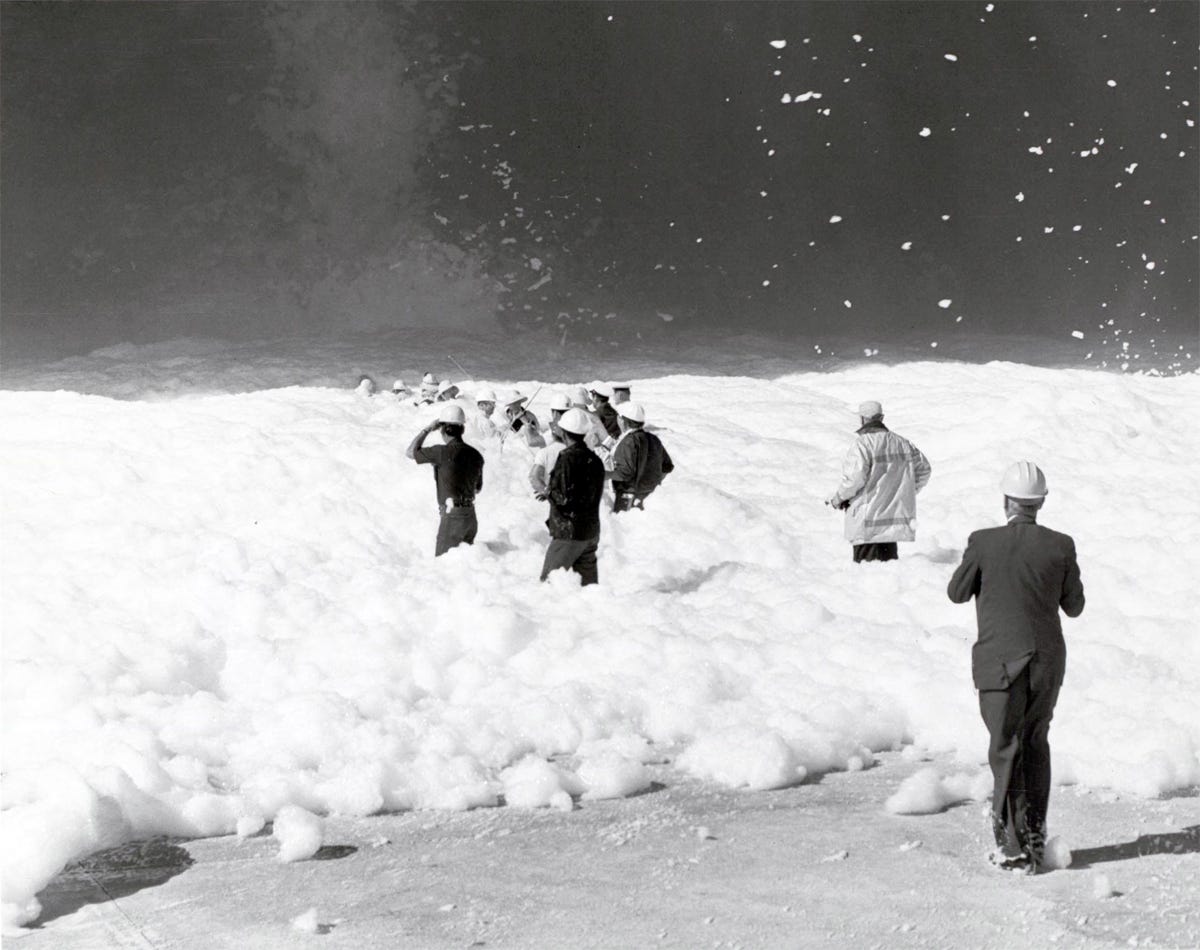
IV. Post-Truth
With each republication of Evidence, the stakes of its semiotic revelation seem to become increasingly potent. As the capacity for truth becomes less of a guarantee within the objects and institutions once seen as reliable sources of guiding thought, the project feels increasingly prescient. Today we are told that we are living in a “post-truth” world, a term granted Word of the Year by Oxford English Dictionary (OED) in 2016.17 While the Word of the Year typically points to a current, if not incredibly brief trend (the last four from OED being brain rot, rizz, goblin mode, and vax), post-truth instead seems to be the marking of a condition that long precedes Oxford’s affirmation. To be sure, Evidence certainly points to a “post-truth” condition rising almost half a century ago in spite of the era lacking such nomenclature. Like a photograph whose significance is born out of everything outside of its frame, the designation of post-truth did not signify a beginning, but was instead indicative of a long and enduring condition that had granted the term its meaning and legitimacy.
The continued popularity of the Evidence would suggest that the semiotic problems and questions of truth contained in Sultan and Mandel’s project have only grown with the life of the book. As we move further into a post-truth culture undergirded by algorithmic feeds, generative AI, and a deluge of information that surpasses any ability for comprehensive fact-checking, the politics of Evidence become increasingly urgent. The question that remains to be answered is: if Evidence were to one day fall back into obscurity, might this imply a reconciliation with the image, in which everyday viewers have reclaimed authority over photographs and therefore grown tired with the book’s revelation, or would it indicate a haunting complacency in which we find ourselves unquestioningly beholden to the image (and its violent narrators), no matter the repercussions? In either case, our objective remains the same: to recognize the gaps resting upon the surface of all images, claim one’s rightful place as an author of their world, and to reject the notion of a single narrative, especially from those for whom the image is nothing more than a convenient means to violent and cunning ends.
McLuhan, Marshall. Understanding Media. 39.
Benveniste, Emile. Problems in General Linguistics. 219.
McLuhan, Marshall. Understanding Media. 39.
Barthes, Roland. Image Music Text. 43.
Today known as Lockheed Martin Corporation.
Phillips, Sandra S. “History of the Evidence” in Evidence. Paragraph 14.
This question may extend to all forms of reissuing in music, film, and television, as well as curatorial practice in instances of works from the (distant or near-distant) past that are brought to light in new contexts. In other words, it is never by mere accident or experiment that we are asked to engage with the past, nor is the renewal of an old work ever intended to be experienced as if solely contained to its original history.
Beniger, David. The Control Revolution. 5.
Beniger, David. The Control Revolution. 24.
Phillips, Sandra S. “History of the Evidence” in Evidence. Paragraph 14.
Foucault, Michel. Lectures on the Will to Know. 23.
Sontag, Susan. On Photography. 17.
Transcript of Colin Powell’s address, February 3 2003. https://www.theguardian.com/world/2003/feb/05/iraq.usa. Emphasis mine.
Adorno, Theodor. Minima Moralia: Reflections from Damaged Life. 150.
Sultan, Larry and Mike Mandel. Evidence. 3-4.
On the mediated images of the Gulf War, see Jean Baudrillard’s The Gulf War Did Not Take Place, 1991.